
 Haoru UWB
Solution
Summary
Haoru Technology provides ultra-wideband (UWB) ranging and positioning data acquisition for automotive tests where distance records are dispersed and trajectories are difficult to align with events. Ranging nodes on test vehicles, with site base stations added where required, supply relative distance, position and timing information to the customer's test platform. The solution supports recording, event retrieval and comparisons between repeated trials under defined conditions.
Application Background
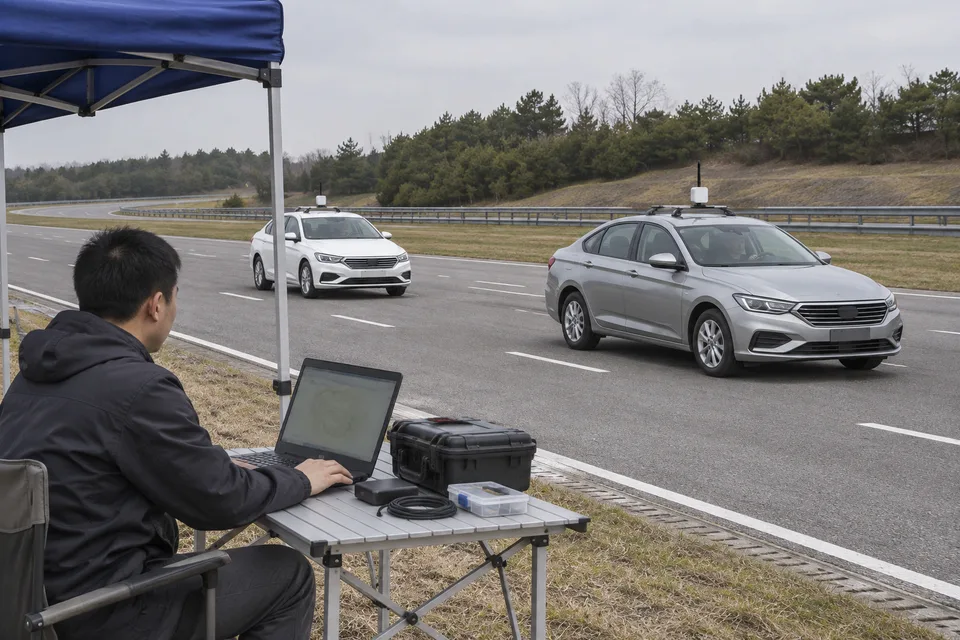
During low speed approach, passing and coordinated movement tests on a closed site, engineers need vehicle distance changes linked with speed, control commands, video and event markers. Video alone or separate equipment logs often require substantial manual preparation before the sequence can be reconstructed.
The customer already has vehicle data acquisition equipment and a test platform. It needs independent relative distance records. Where site trajectories are required, vehicle positions are also referenced to a common frame so that routes and events can be compared between test batches.
Project Challenges
1. Relative distance and site trajectories are different measurements. The distance between two vehicle nodes alone cannot determine their complete site positions or attitudes.
2. Mounting affects interpretation. Node distance is not the same as vehicle body clearance, so mounting offsets and the relevant measurement direction must be recorded.
3. Test devices sample at different intervals. Ranging, vehicle states, video and event markers need a common time reference, with gaps and exceptions retained.
Haoru Technology Solution
Haoru Technology installs UWB ranging nodes at suitable vehicle locations and calibrates their relationship to body reference points. Two-way ranging creates an independent relative distance record. Measurement direction, mounting and test speed are defined for the selected conditions, rather than treating node distance directly as bumper clearance.
For tasks requiring site coordinates, we deploy base stations in a defined area and calculate vehicle tag positions. Ranging and positioning records remain separate, then enter the customer platform alongside speed, control states and video. Vehicle attitude comes from existing inertial or other sensors, not from a single distance measurement.
Project integration aligns data sources in time and records task numbers, device identities and data status. Engineers retrieve distance changes and trajectories by event, with incomplete sections explicitly identified. This channel supports test recording and analysis; the customer's test control system remains responsible for vehicle motion.
How It Works
1. Prepare the task: record vehicles, mounting offsets and test conditions, then establish task and event identifiers.
2. Acquire measurements: vehicle nodes perform UWB two-way ranging. A site positioning system also supplies coordinates where trajectories are required.
3. Align records: the customer platform connects distance, coordinates, vehicle states and video through common timing, retaining gaps and exceptions.
4. Compare trials: retrieve approach, passing and stopping events, then compare distance curves and site trajectories across runs.
Solution Advantages
1. Relative distance and site position are supplied according to the task and remain clearly distinguished.
2. Mounting offsets, timing and data status stay with the records, supporting interpretation and test reproduction.
3. Interfaces connect to existing acquisition platforms so teams can retain their vehicle state, video and analysis tools.
Final Results
Time spent aligning relative distance and vehicle state data decreased by 60%. Common task and time records reduce manual file matching.
Additional repeat tests caused by missing measurement data decreased by 40%. Recorded data status helps teams check incomplete sections promptly.
Time spent locating test exception segments decreased by 70%. Event markers retrieve the relevant distance, trajectory and video records without searching each sequence manually.