
 Haoru UWB
Solution
Abstract
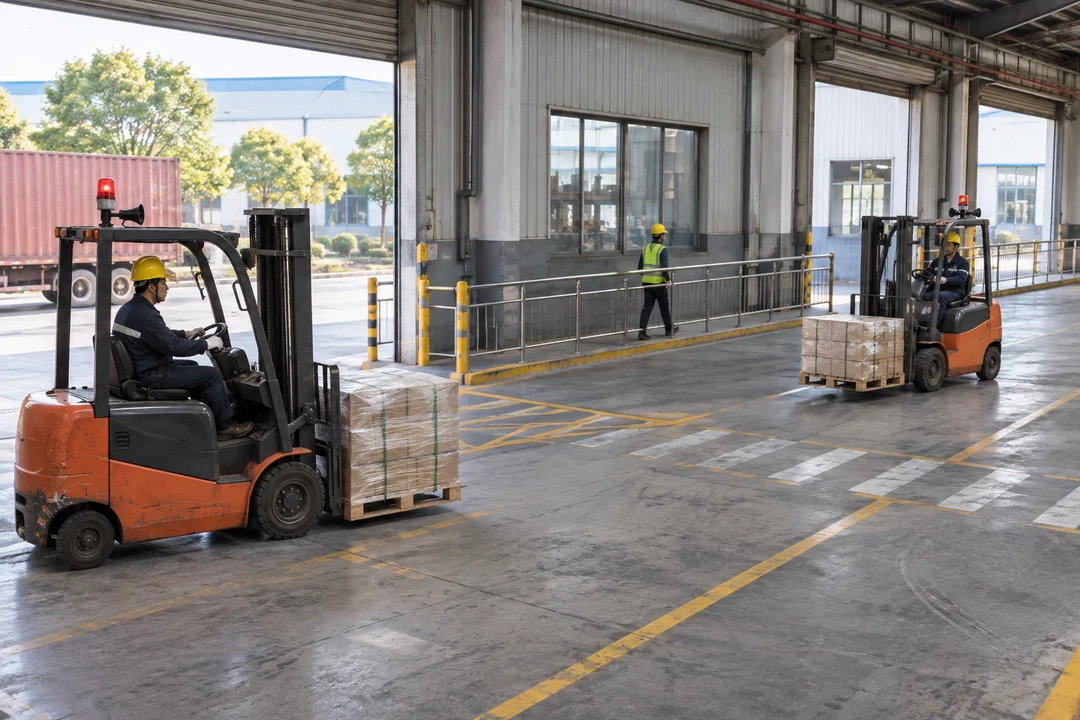
For forklift operations in warehouses and factories, Haoru Technology builds human-machine anti-collision warning with UWB ranging. Ranging terminals are installed on forklifts and tags are carried by personnel, measuring the distance between forklifts and personnel as well as between forklifts in real time. When the distance falls below a preset threshold, the terminal issues an audible and visual alarm, helping drivers slow down and avoid collisions in shared work areas.
1. Background
In warehouses and factories, forklifts and workers often operate in the same aisles, loading areas and intersections. Forklifts have blind spots, making it hard for drivers to notice people behind them or around rack corners in time, while workers carrying goods or looking down may not notice an approaching forklift. Traditional mirrors, warning lights and whistles have limited effect, and the risk of human-machine collision remains.
2. Project Challenges
First, blind spots are hard to cover. Areas behind the forklift, around rack corners and blocked zones cannot be observed visually, and drivers can easily overlook nearby personnel when reversing or turning.
Second, reminders are passive. Mirrors and warning lights require people to notice them actively, and whistles and shouting are easily missed in noisy environments, so there is no proactive prompt when danger approaches.
Third, multi-vehicle crossing is complex. When multiple forklifts operate at the same time, there is also a collision risk between forklifts, which is hard to cover fully by human observation alone.
3. Haoru Technology's Solution
Haoru Technology installs UWB ranging terminals on forklifts and equips workers with portable tags. The terminals measure the distance between forklifts and personnel, and between forklifts, in real time. When the distance falls below a preset threshold, the terminal alerts drivers and nearby personnel with an audible and visual alarm to slow down and avoid. The system supports many-to-many ranging, with each forklift and tag having its own identity, and the alarm distance can be adjusted according to aisle width and vehicle speed to match the working pace of different sites.
4. How It Works
The ranging terminals on forklifts continuously perform UWB two-way ranging with personnel tags, calculating the distance between them in real time; forklifts also measure the distance between each other through their ranging terminals. When the measured distance falls below the set safety threshold, the terminal triggers an audible and visual alarm immediately, prompting the driver to slow down or stop and avoid; the alarm clears automatically once the distance returns to the safe range.
5. Solution Advantages
First, proactive warning. The system turns "people avoiding actively" into "alerts on approach", warning both sides before danger occurs and covering blind spots.
Second, flexible deployment. There is no need to lay magnetic strips, beacons or other infrastructure; terminals are installed on forklifts and tags are carried by personnel, adapting to changing work areas.
Third, adjustable distance. The alarm distance can be adjusted according to aisle width, vehicle speed and on-site pace, balancing safety and efficiency.
6. Results
The rate of timely warnings for dangerous approach between people and machines in forklift areas increased by 90%, shifting from passive reminders to active alarms.
Scraping and collision hazards caused by blind spots decreased by 70%, with alerts on approach and early avoidance.
The time for drivers to confirm nearby personnel in shared work areas shortened by 65%, with audible and visual alarms replacing visual observation.