
 Haoru UWB
Solution
Summary
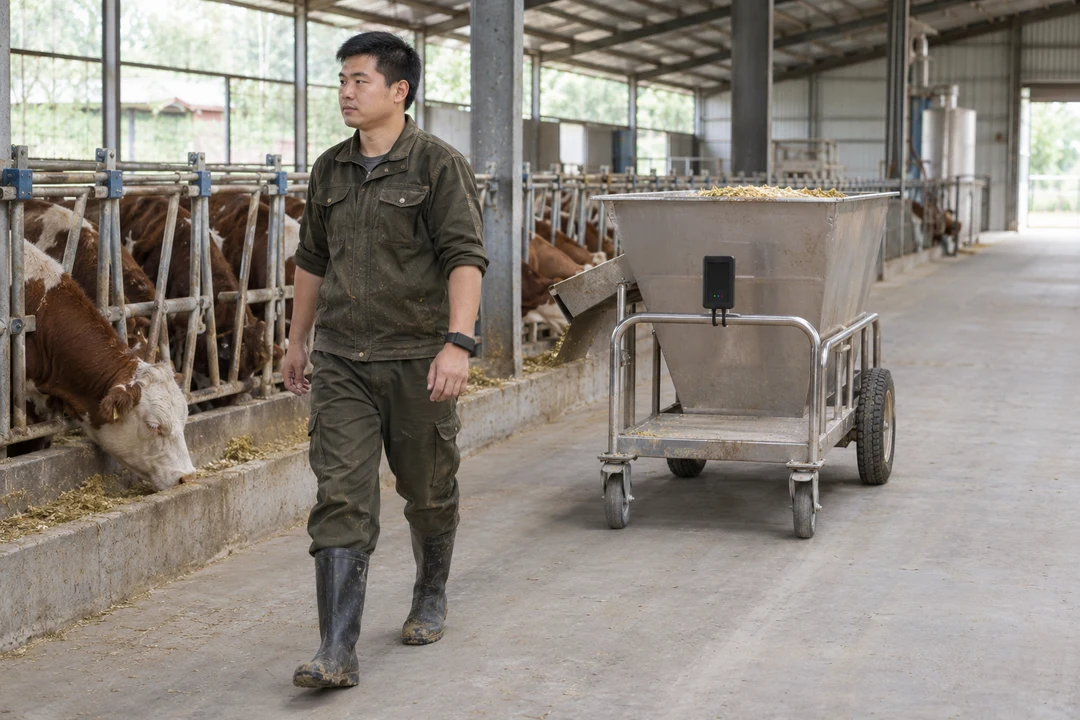
Haoru Technology integrates ultra-wideband (UWB) automatic following into customer feeding vehicles to reduce the need to push a cart while distributing feed. The vehicle follows a designated stockperson along a separated service aisle, moving and stopping in coordination with the customer's existing hopper and dispensing equipment. Staff can carry out feeding across successive sections with fewer auxiliary movements.
Application Background
On farms using operator led feeding, staff move along an aisle, inspect troughs, control dispensing and push the vehicle to the next location. Switching repeatedly between feeding and moving the vehicle adds auxiliary work.
The customer already has a feed vehicle, hopper or dispensing mechanism. It wants following assistance while retaining its feed management process. The staff member is the following target, and the vehicle operates in an aisle separated from animal activity areas.
Project Challenges
1. Feed consumption continuously changes payload and center of gravity. Starting, turning and stopping must be tuned for full and near empty loads.
2. Aisles can contain moisture, spilled feed and cleaning water. Structure, tires, electrical protection and cleaning procedures must be assessed together.
3. Vehicle movement and dispensing need clear coordination. Following data cannot determine animal nutritional needs or replace dispensing measurement and start and stop control.
Haoru Technology Solution
Haoru Technology assesses the customer's chassis, braking, payload and power, then configures following modules, a controller and compatible drive components. Vehicle base stations are positioned away from metal hoppers and feed access points. Mounting supports maintenance, with electrical protection and cleaning arrangements adapted to site conditions.
The stockperson carries a tag. Relative UWB distance and direction guide the vehicle along the service aisle. At a feeding point, staff pause the vehicle and operate the existing dispensing equipment, restarting following when moving to the next section. Hopper securing and feed access order are arranged to reduce unnecessary turning and vehicle retrieval.
Where coordination signals are required, a project interface provides moving or stationary status to the dispensing controller. The customer's mechanism retains feed measurement and dispensing control. Configured obstacle detection triggers stopping, with manual takeover near gates, corners and difficult surfaces. Speed, steering and stopping are tuned at full, partial and empty loads.
How It Works
1. Prepare the vehicle: check hopper securing, the aisle and battery, then bind the current staff tag.
2. Identify and follow: UWB modules measure the staff member's relative position and the controller adjusts vehicle motion.
3. Stop and dispense: staff pause the vehicle and operate the dispensing mechanism once stationary. An adapted interface supplies vehicle status where required.
4. Continue the task: restart following after dispensing, stop for detected obstacles and use manual takeover at special locations.
Solution Advantages
1. Staff organize work around feeding and observation, with less switching between dispensing and continuous pushing.
2. The customer's hopper, metering and dispensing equipment remain in use, with following integrated into the existing structure.
3. Tuning accounts for changing loads and aisle conditions, matching movement to the feeding process.
Final Results
Time spent manually pushing the vehicle during feeding decreased by 60%. Powered following handles travel along the service aisle.
Feed spillage during transport decreased by 30% for the same supplied quantity. Secured hoppers and smoother starting and stopping reduce losses during movement.
Return trips from feeding points to retrieve the vehicle decreased by 40%. Movement follows the operator's pace, reducing cases where the cart remains in the previous section.