
 Haoru UWB
Solution
Summary
Haoru Technology provides ultra-wideband (UWB) vehicle position data integration for rail maintenance depots where arrival updates are delayed and work bay occupancy requires manual verification. Vehicle positions are linked to tracks, maintenance sections and tasks to identify entry, placement and departure events. Continuous records support maintenance dispatch and work bay resource planning.
Application Background
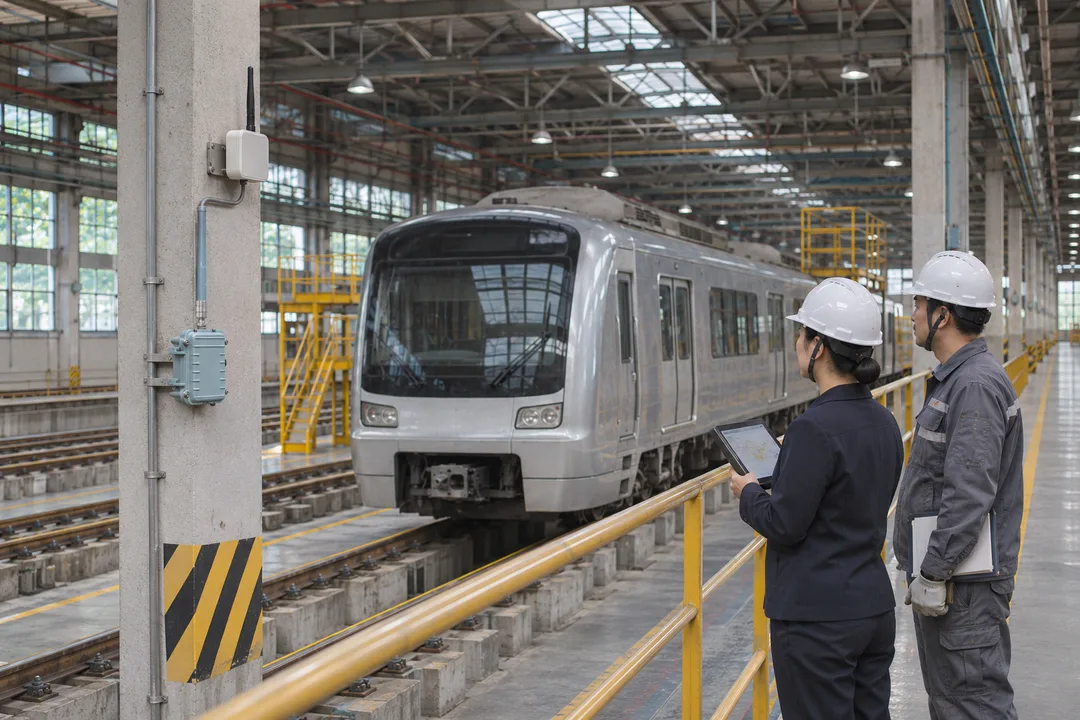
Rail vehicles entering a maintenance depot must stop on the track and at the work bay assigned to their task. Dispatchers arrange arrival order, maintenance teams confirm placement, and completed work must be coordinated with vehicle movements and subsequent tasks.
Vehicle positions and bay status are often recorded separately on site boards, in task applications or in manual forms. When a vehicle moves before its record is updated, dispatchers must contact the team again. This delays bay release and subsequent planning. The customer needs location data to supplement its maintenance workflow.
Project Challenges
1. Adjacent tracks are close together, while vehicle bodies and steel structures obstruct signals. A single position reading can misidentify a section, requiring trajectory continuity and site layout checks.
2. A long vehicle can occupy several work areas. The tag position differs from the full occupied envelope, so vehicle length and stopping direction must be included.
3. Physical occupancy differs from maintenance status. Departure does not automatically complete a task, and arrival does not establish that work authorization conditions are met.
Haoru Technology Solution
Haoru Technology deploys UWB base stations around selected maintenance areas, installs accessible vehicle tags and calibrates tracks against site coordinates. We provide position calculation, trajectories and data interfaces, adapting node placement to metal obstructions.
The maintenance platform links tags with vehicle identities, consist information and tasks. Project logic combines direction, vehicle length, position continuity and dwell time to determine occupied sections and generate entry, placement and departure events.
The platform displays physical occupancy, task progress and work authorization separately. Dispatchers use the information to allocate bays; teams confirm maintenance start, completion and release through existing procedures. Positioning is integrated as supplementary maintenance information. Existing systems retain responsibility for railway signals, equipment interlocks and work approvals.
How It Works
1. Associate the vehicle: bind its tag to the vehicle and task, recording length, direction and other inputs needed to assess occupancy.
2. Collect continuously: calculate UWB tag positions and map coordinates to calibrated tracks and sections.
3. Identify occupancy: use continuous positions and dwell records to detect placement and departure, then account for the vehicle envelope.
4. Coordinate dispatch: display position events beside maintenance status, retain staff confirmations and approvals, and support historical review.
Solution Advantages
1. Linking locations with maintenance tasks reduces repeated inquiries between dispatchers and maintenance teams.
2. Managing the occupied vehicle envelope avoids overlooking a long body that extends beyond the tag's section.
3. Existing approval and protective systems remain in place while independent position records improve bay resource information.
Final Results
Time spent manually verifying work bay occupancy decreased by 70%. Dispatchers consult the vehicle's section and occupancy records instead of contacting each team.
Manual supplementary entries for vehicle movements decreased by 60%. Entry, placement and departure events are associated with each vehicle, reducing later registration.
Delay in updating bay release information after vehicle departure decreased by 50%. Position events promptly indicate physical occupancy changes and help dispatchers coordinate the next task.