
 Haoru UWB
Solution
Abstract
For the management of inmates in prisons and detention centers, Haoru Technology builds a location foundation with UWB high-precision positioning. Through positioning wristbands, the system tracks inmate locations and trajectories in real time, enabling boundary-crossing alerts, gathering warnings and tag-tamper reporting. It frees correctional officers from repeated roll calls and patrols, allowing them to focus on supervision and emergency response.
1. Background
Managing inmates in prisons and detention centers has long relied on manual roll calls, scheduled patrols and video surveillance. Correctional officers count and record inmate locations on every shift and patrol key areas repeatedly at night. This approach is labor-intensive and leaves blind spots between roll calls or patrols. In an emergency, staff often have to search room by room and review footage segment by segment to confirm an inmate's location.
2. Project Challenges
First, patrol blind spots. Between two roll calls or patrols, the real-time location of inmates cannot be known. The supervision of key inmates, sensitive areas and night shifts relies on constant manual attention, leaving gaps in observation.
Second, boundary crossing and gathering are hard to detect in time. Crossings between cell blocks, work areas and medical rooms, as well as unusual gatherings of multiple inmates, can mostly only be confirmed after the fact by reviewing footage, rather than being intervened at the first moment.
Third, the reliability of tag wearing. Positioning tags must be worn by inmates over the long term, with an anti-tamper design that reports damage or removal immediately; otherwise the positioning system loses its reference value.
3. Haoru Technology's Solution
Haoru Technology deploys UWB base stations across cell blocks, corridors, work areas and common areas, equips inmates with positioning wristband tags, and outputs each inmate's real-time location, trajectory and area status through the host software, providing centimeter-level positioning capability. The system feeds location data into the facility's management platform, where electronic fences and gathering thresholds are set for each area. When an inmate crosses a boundary, stays in one place too long, or gathers unusually with others, the system raises an alert automatically; when a wristband is damaged or removed, it reports the anomaly immediately, and the duty room receives a prompt at the same time. The number of base stations is determined by the facility's floor plan. Two-dimensional positioning normally uses at least three base stations, with four commonly used in regular projects.
4. How It Works
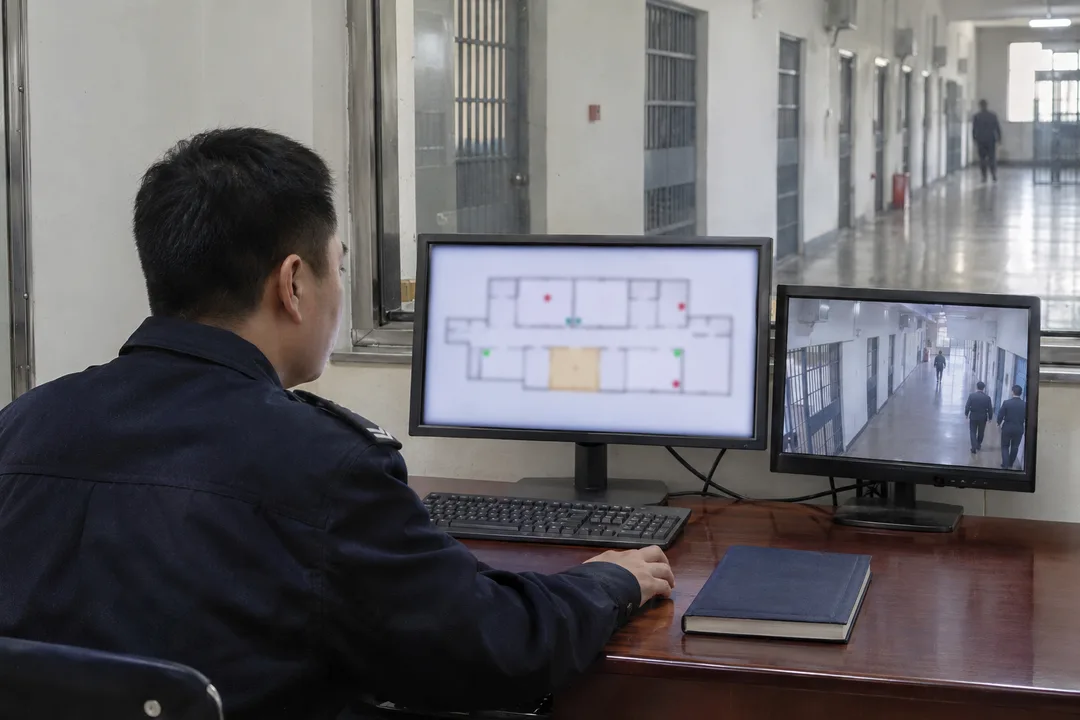
The positioning wristbands worn by inmates communicate continuously with the base stations deployed across the facility. The base stations aggregate ranging data to the host software, which computes each inmate's real-time coordinates. The host software forwards coordinates, trajectories and area information to the management platform, which compares inmate positions against electronic fences according to preset rules, triggers boundary-crossing, gathering or tag-anomaly alerts, and marks the corresponding inmates and areas on the electronic map for rapid response.
5. Solution Advantages
First, real-time location awareness. Discrete roll-call management becomes continuous location tracking, reducing blind spots between patrols and giving a clear view of key inmates' movements.
Second, instant alerts for anomalies. Boundary crossings, gatherings and tag tampering are reported automatically, turning event detection from after-the-fact review into real-time prompts and shortening response time.
Third, traceable trajectories. The system keeps complete records of inmate trajectories, providing objective evidence for incident review, investigation and supervision analysis.
6. Results
Time spent on roll calls and manual patrols decreased by 55%, with location checks completed by the system in real time.
The time to detect boundary-crossing and gathering incidents shortened by 70%, shifting from after-the-fact review to instant alerts.
The time to confirm an inmate's location during an emergency decreased by 80%, allowing emergency response to locate individuals directly.