
 Haoru UWB
Solution
Abstract
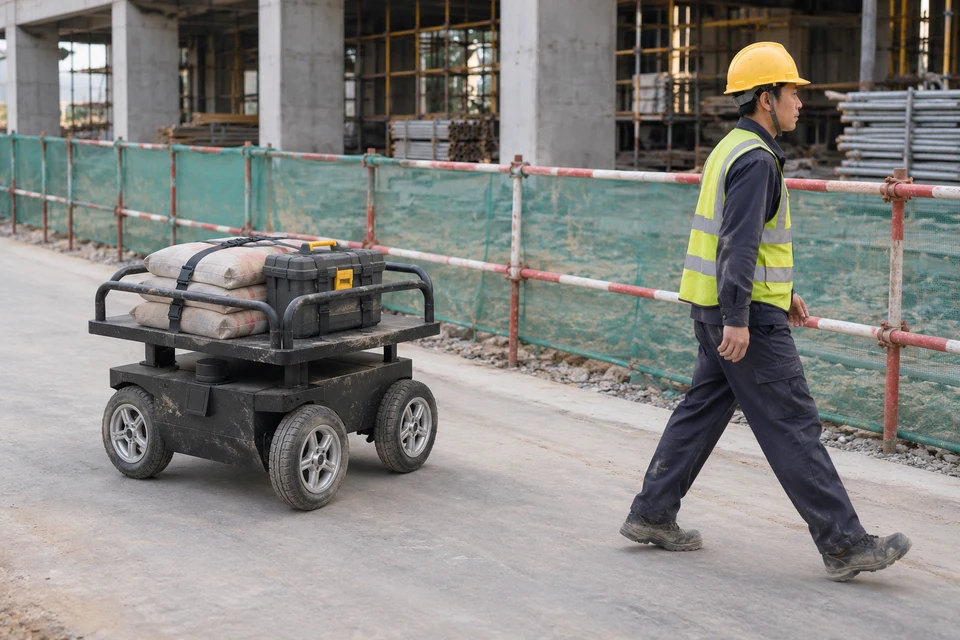
For handling building materials and tools on construction sites, Haoru Technology provides UWB automatic following vehicles. Workers wear wristband tags, and the cart follows them automatically between work areas and material zones, with no manual pushing, letting workers keep both hands for construction and reducing the handling burden on site.
1. Background
On construction sites, workers move building materials, tools and auxiliary items back and forth between work areas and material storage zones. Cement, bricks, pipes and tools are heavy and bulky, so workers use hand carts or carry them manually, making frequent trips that are physically demanding. With multiple trades working at the same time, material handling takes up a great deal of labor and time.
2. Project Challenges
First, heavy handling. Building materials and tools are heavy and bulky, and manual carrying plus repeated cart trips drain workers' energy, affecting construction efficiency.
Second, scattered work areas with uneven ground. Site work areas are scattered, and there are level differences and slopes between floors and areas, so handling equipment needs a certain degree of mobility.
Third, varied materials. Cement, bricks, pipes and tools come in different shapes, so the cart needs sufficient payload and loading capacity.
3. Haoru Technology's Solution
Haoru Technology provides UWB automatic following vehicles. Workers wear wristband tags, and the cart recognizes the worker's position through UWB ranging and angle measurement, following automatically with an adjustable following distance of 1 to 15 meters and a rated payload of 300 kg, using four-wheel drive to suit slopes and uneven ground between work areas. The cart requires no magnetic strips or tracks; it follows the worker wherever they go. The cart is equipped with ultrasonic sensors and stops automatically when approaching obstacles.
4. How It Works
The wristband tag worn by the worker communicates continuously with the UWB base stations installed on the cart. The base stations measure the distance and angle between the worker and the cart, and the following controller drives the wheels according to this data to make the cart move forward, turn or stop. When the worker stops to fetch materials or work, the cart stops at a set distance and waits; when the worker moves, the cart resumes following. When the ultrasonic sensors detect an obstacle at close range, the cart stops automatically.
5. Solution Advantages
First, reduced handling burden. The cart moves with the worker, carrying materials and tools along, reducing trips to material zones and manual handling.
Second, suited to site ground. Four-wheel drive provides a certain degree of climbing and mobility, adapting to slopes and uneven ground between work areas.
Third, flexible operation. The cart moves dynamically with the worker without fixed tracks, suiting multi-trade and changing-route site work.
6. Results
Workers' daily time spent on handling and travel decreased by 50%, with materials and tools moving along without manual pushing.
Labor invested in material handling decreased by 40%, with handling taken over by the cart.
The time for materials to reach work areas shortened by 35%, with the cart following and materials available on demand.