
 Haoru UWB
Solution
Abstract
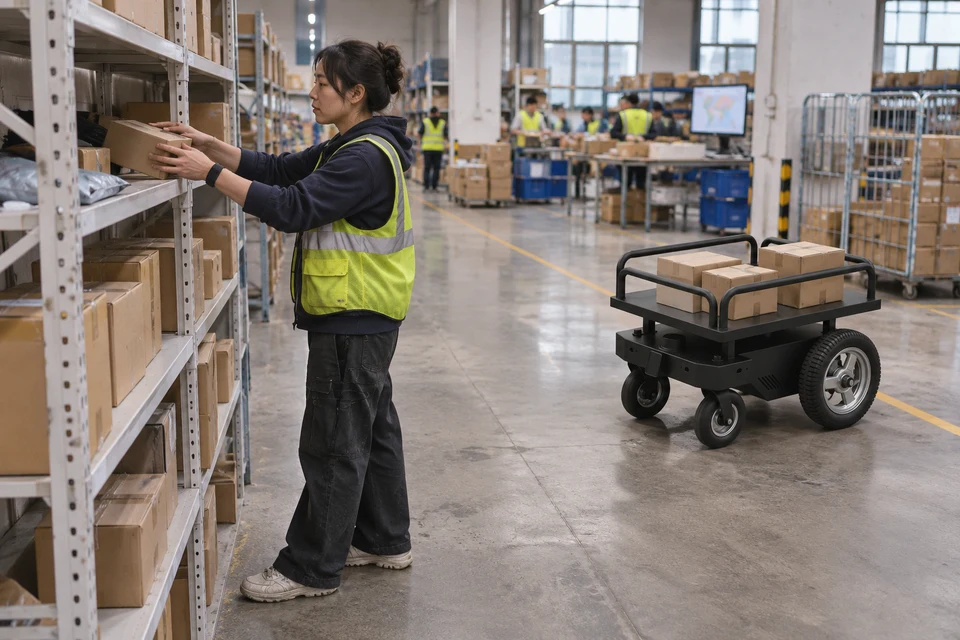
For sorting and handling in express transit centers and e-commerce warehouses, Haoru Technology provides UWB automatic following vehicles. Workers wear wristband tags, and the cart follows them automatically between sorting areas, slots and loading areas, with no manual pushing, letting workers keep both hands for picking, sorting and loading and improving transit efficiency.
1. Background
In express transit centers and e-commerce warehouses, sorters move parcels back and forth between sorting areas, slots and loading areas. Traditionally, sorters use hand carts or electric carts to carry parcels, pushing with one hand and picking with the other, making repeated trips between slots and loading areas. This is physically demanding and sorting efficiency is limited by handling speed.
2. Project Challenges
First, handling occupies both hands. Sorters need one hand to push the cart and the other to pick and sort, so handling and sorting cannot be done efficiently at the same time, slowing the pace.
Second, frequent travel with changing routes. Parcels go to scattered destinations, and sorting routes change dynamically, so fixed tracks and magnetic strips cannot adapt to this flexible work.
Third, large sites with moving people. Transit centers are large with dense sorters and vehicles, so the cart needs stop-on-obstacle capability to avoid collisions.
3. Haoru Technology's Solution
Haoru Technology provides UWB automatic following vehicles. Workers wear wristband tags, and the cart recognizes the worker's position through UWB ranging and angle measurement, following automatically with an adjustable following distance of 1 to 15 meters and a rated payload of 100 kg. The cart requires no magnetic strips, QR codes or beacons; it follows the worker to whichever slot they go. The cart is equipped with ultrasonic sensors and stops automatically when approaching obstacles, suiting the flow of people and parcels in sorting areas.
4. How It Works
The wristband tag worn by the worker communicates continuously with the UWB base stations installed on the cart. The base stations measure the distance and angle between the worker and the cart, and the following controller drives the wheels according to this data to make the cart move forward, turn or stop. When the worker stops to sort, the cart stops at a set distance and waits; when the worker moves to the next slot, the cart resumes following. When the ultrasonic sensors detect an obstacle at close range, the cart stops automatically.
5. Solution Advantages
First, hands are freed. Workers no longer need to push the cart and can focus on picking and sorting, keeping the pace of work from being slowed by handling.
Second, flexible adaptation. The cart moves dynamically with the worker without fixed tracks or infrastructure, suiting scattered parcel destinations and changing routes.
Third, safe stop-on-obstacle. Ultrasonic sensors stop the cart automatically when approaching people or parcel piles, reducing collision risk.
6. Results
Sorters' daily time spent on handling and travel decreased by 50%, with carts moving along automatically without manual pushing.
Per-capita sorting throughput increased by 35%, with both hands focused on picking and sorting.
Parcel damage and delays caused by cart collisions decreased by 45%, with automatic stop-on-obstacle on approach.