
 Haoru UWB
Solution
Summary
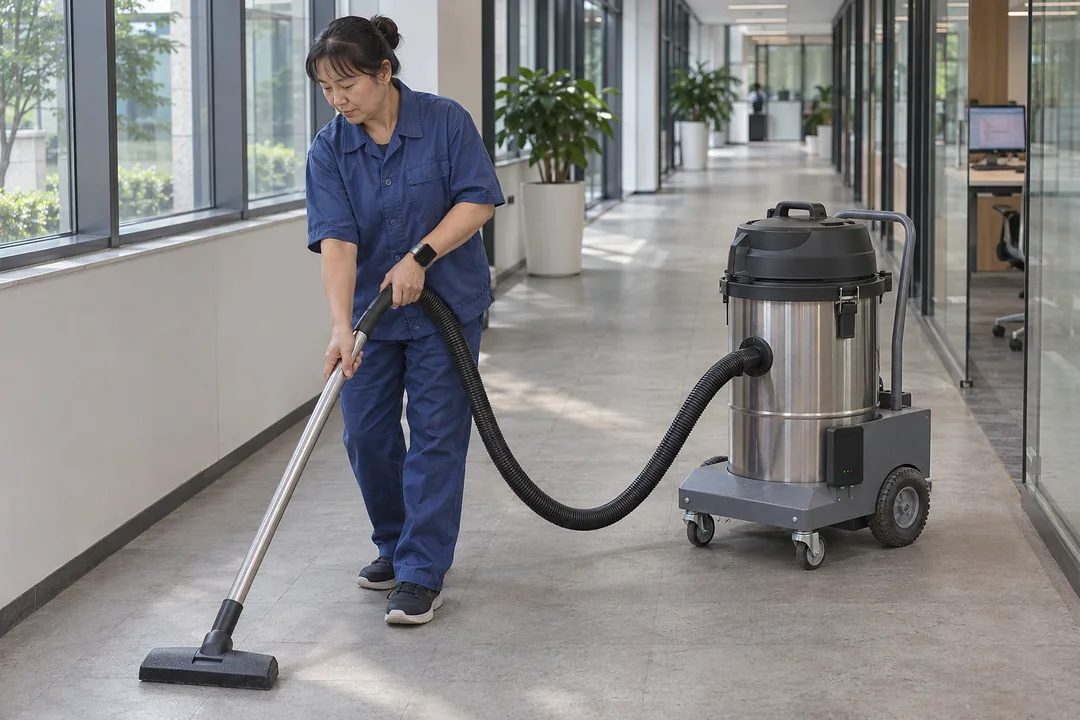
Haoru Technology integrates ultra-wideband (UWB) automatic following into the mobile base of customer vacuum equipment to reduce repeated dragging, hose pulling and repositioning. The unit follows a designated cleaner within a defined area, maintaining a distance suited to the hose working range. Pausing and manual adjustment support detailed work and movement between areas, reducing auxiliary handling during vacuuming.
Application Background
When using commercial canister or hose based vacuum equipment, cleaners operate the nozzle while frequently managing the hose or pulling the main unit. If the unit stays behind, the hose becomes taut. Moving to another aisle can require returning to reposition the equipment.
The customer already has the vacuum unit, hose, nozzle and power arrangement. It wants a mobile base retrofit that preserves cleaning functions and adds movement assistance to a process directed by the operator, keeping the unit closer to the cleaner's working rhythm.
Project Challenges
1. Following distance must suit hose length and bending space. Excessive separation pulls the hose tight, while insufficient distance can interfere with turning and nozzle operation.
2. Floor level hoses and power cables can enter the wheel path. Obstacle sensors cannot be assumed to detect thin cables reliably, requiring physical routing and operating procedures.
3. Collected material changes unit weight. The retrofit must account for center of gravity, vibration, wheels and existing maintenance access.
Haoru Technology Solution
Haoru Technology adds powered motion and following to the customer's mobile base using UWB modules, a following controller and compatible drive components. The customer's main unit, hose and nozzle retain cleaning responsibility. Our scope focuses on movement, steering and stopping of the unit.
The cleaner carries a tag, allowing the system to measure relative distance and direction. Following distance is tuned to effective hose length, working reach and available aisles. Manual pause is retained so the unit can wait while the operator turns, cleans a corner or manages the hose.
Hose retention and guides are adapted to the equipment structure to keep slack away from wheels. Corded equipment uses the customer's cable reel or manual cable management process. Detected obstacles trigger stopping. Operators take over in narrow locations and at cable crossings, and motion is checked with both empty and loaded collection containers.
How It Works
1. Prepare the task: secure the unit and hose guides, check power cable routing and associate the cleaner's tag.
2. Measure relative position: UWB modules supply distance and direction, which the controller uses with the selected spacing to move the base.
3. Support vacuuming: the cleaner operates the nozzle while the unit follows at a suitable distance. Following is paused for detailed work.
4. Manage transitions: detected obstacles cause stopping. Staff check hoses, power cables and special passages and take control where required.
Solution Advantages
1. Cleaning remains under operator control while following directly reduces unit dragging and repositioning.
2. A mobile base retrofit preserves the customer's vacuum unit and cleaning accessories.
3. Distance, pause procedures and hose routing are tuned together to fit the actual cleaning process.
Final Results
Manual movements of the vacuum unit decreased by 70%. The powered base follows the cleaner's position, reducing returns to pull the unit forward.
Work interruptions caused by hose pulling decreased by 50%. Suitable separation and hose guides reduce sudden tension.
Total cleaning task time per area decreased by 20%. Less auxiliary handling and fewer interruptions allow more continuous vacuuming.