
 Haoru UWB
Solution
Abstract
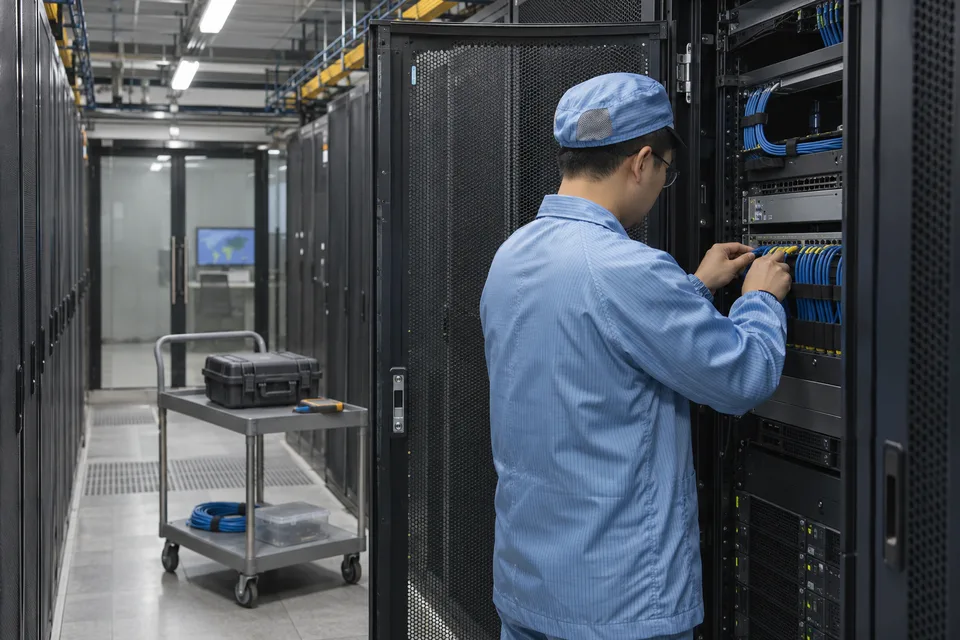
For inspection and maintenance in data center machine rooms, Haoru Technology integrates the UWB automatic following kit into customers' own inspection tool carts. The carts follow maintenance engineers wearing wristband tags automatically, so tools and spare parts travel with them, reducing trips to fetch items and improving inspection efficiency.
1. Background
Maintenance engineers in data center machine rooms need to carry tools, spare parts and test equipment while inspecting between racks. The racks are densely arranged with narrow aisles, so engineers often have to go to the tool room first and then return to the racks, making repeated trips when faults occur at different racks. Tools and spare parts need to travel with the engineer, but machine room aisles are not suitable for pushing large carts through.
2. Project Challenges
First, frequent trips to fetch items. When engineers work between racks, tools and spare parts have to be fetched from the tool room repeatedly, taking up a great deal of time.
Second, narrow aisles and dense equipment. Machine room aisles are narrow and racks are densely arranged, so the cart needs to turn flexibly and have stop-on-obstacle capability to avoid hitting racks and equipment.
Third, high static and safety requirements. The machine room environment demands high equipment safety, so the cart must move smoothly to avoid damage from collisions.
3. Haoru Technology's Solution
Haoru Technology integrates the UWB automatic following kit into customers' own inspection tool carts. Engineers wear wristband tags, and the cart recognizes the engineer's position through UWB ranging and angle measurement, following automatically with an adjustable following distance of 1 to 15 meters. The tool cart moves with the engineer between racks, with tools and spare parts traveling along, eliminating trips back to the tool room. The cart is equipped with ultrasonic sensors and stops automatically when approaching racks, equipment or people to avoid collisions.
4. How It Works
The wristband tag worn by the engineer communicates continuously with the UWB base stations installed on the tool cart. The base stations measure the distance and angle between the engineer and the cart, and the following controller drives the motors according to this data to make the cart move forward, turn or stop. When the engineer stops to work, the cart stops at a set distance and waits; when the engineer moves, the cart resumes following. When the ultrasonic sensors detect an obstacle at close range, the cart stops automatically.
5. Solution Advantages
First, travel with the engineer. Tools and spare parts travel with the engineer, reducing trips to the tool room and keeping inspection uninterrupted.
Second, flexible movement. The cart turns flexibly between racks with the engineer, without fixed tracks, suiting the dense arrangement of the machine room.
Third, safe stop-on-obstacle. Ultrasonic sensors stop the cart automatically when approaching racks and equipment, reducing collision risk.
6. Results
The time engineers spent traveling to and from the tool room during inspection decreased by 55%, with tools and spare parts traveling along.
The time to handle a single rack fault shortened by 30%, with fewer fetching trips and continuous work.
The risk of equipment scraping caused by carts in the machine room decreased by 60%, with automatic stop-on-obstacle on approach.