
 Haoru UWB
Solution
Summary
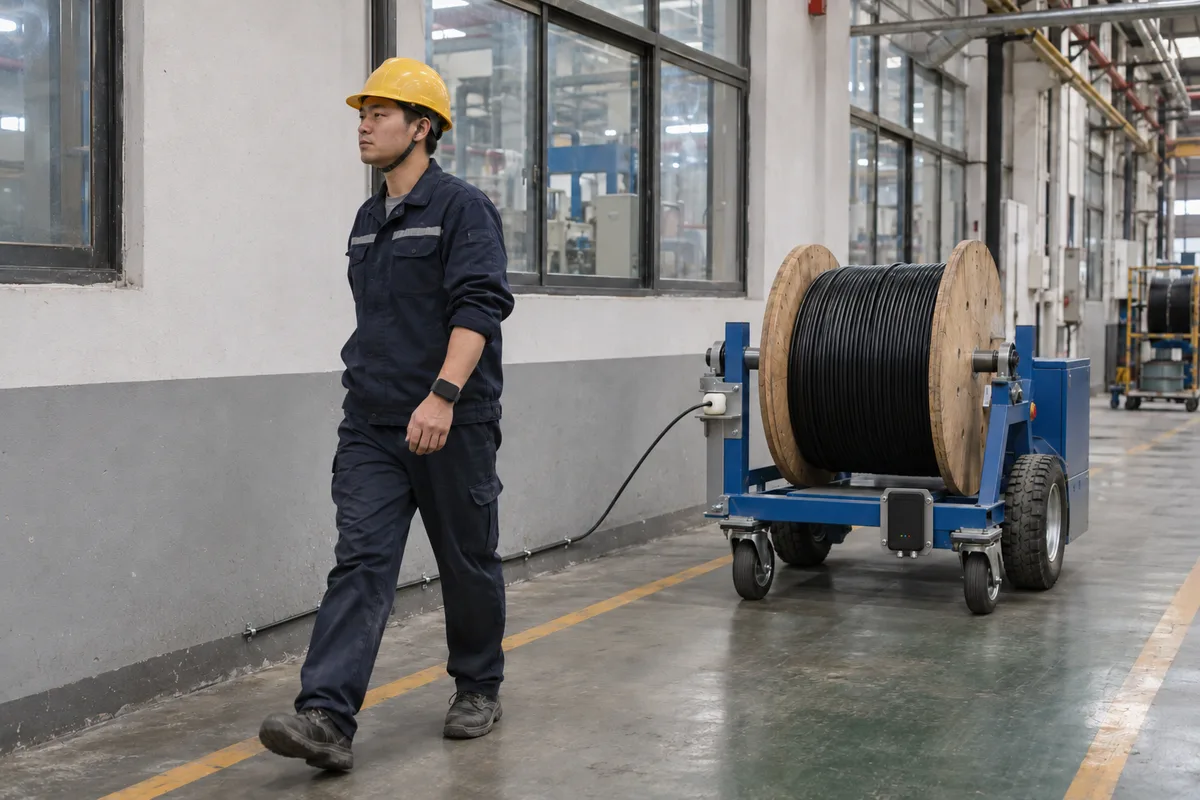
Haoru Technology integrates ultra-wideband (UWB) automatic following into customer cable payout vehicles to reduce repeated repositioning, slack accumulation and return trips during cable laying. The vehicle follows a designated worker and coordinates movement, stopping and payout with the customer's existing release, braking and tension control mechanisms within a defined installation aisle.
Application Background
During factory construction, equipment installation and cable laying within a site, workers move along the route while a payout vehicle carries the reel and supplies cable. If it falls too far behind, staff must return to move it. Mismatched vehicle movement and reel release can also pull the cable tight or create slack piles.
The customer already has a payout vehicle, reel support and release mechanism. It wants the vehicle to move more easily with the work sequence. The solution retains the existing installation process and tension control while adding following assistance to low speed work directed by staff.
Project Challenges
1. Reel weight changes as cable is released. Starting, stopping and turning must account for both payload and reel inertia.
2. Worker position does not directly represent cable tension. Release control needs independent feedback rather than relying solely on the distance between worker and vehicle.
3. Floor cables, temporary supports and corners affect travel. Obstacle sensing alone cannot reliably manage thin cables, requiring guides and manual takeover procedures.
Haoru Technology Solution
Haoru Technology assesses the vehicle frame, wheels, braking, power and reel securing arrangement, then configures UWB following modules, a controller and compatible drive components. Vehicle base stations are mounted away from metal reel obstruction, while access to payout controls and maintenance points is retained.
A worker carries the tag, and the vehicle follows relative distance and direction along the defined route. The customer's payout controller continues to regulate release and braking using tension sensing, drum status and process requirements. UWB supplies target position and vehicle movement references rather than replacing tension feedback.
Where coordination is required, a project interface exchanges stationary, moving and pause states. Staff pause following before pulling, organizing cable or turning a corner, then confirm cable routing and vehicle clearance before continuing. Customer guides direct cable away from the wheels. Detected obstacles trigger stopping, and staff take over at special locations.
How It Works
1. Prepare the reel: secure the load, check guides, payout braking and the route, then associate the worker's tag.
2. Guide movement: UWB measures worker distance and direction, and the controller adjusts the base to approach work points at the installation pace.
3. Coordinate payout: the customer's mechanism regulates release using its own tension and drum feedback, with vehicle status supplied through an adapted interface.
4. Pause and relocate: stop for cable handling, corners or detected obstacles. Staff check conditions before resuming following or taking manual control.
Solution Advantages
1. Powered following reduces return trips to reposition the payout vehicle during continuous installation.
2. Following and tension control retain their respective feedback, supporting integration with different customer payout mechanisms.
3. Pause procedures, guides and state exchange coordinate the cable and vehicle, fitting movement assistance into the laying process.
Final Results
Manual repositioning of payout equipment decreased by 70%. The vehicle moves with installation staff, reducing returns after each completed section.
Cable slack clearing interventions decreased by 50%. Coordinated vehicle states and independent tension feedback reduce mismatches in cable release.
Total cable laying task time per section decreased by 25%. Less auxiliary movement and cable handling improve continuity of the installation sequence.