
 Haoru UWB
Solution
Abstract
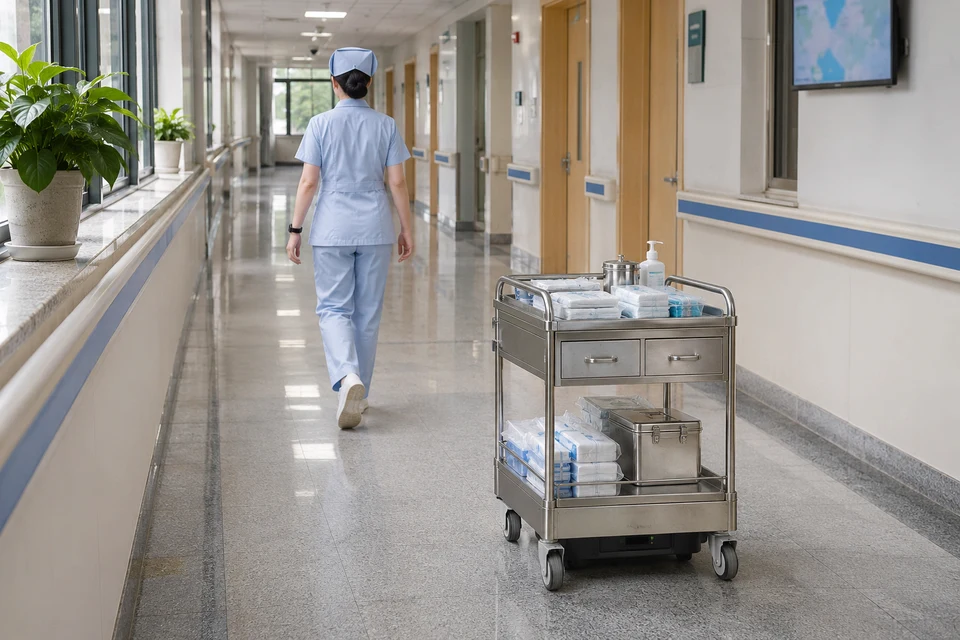
For mobile nursing and dressing tasks in hospital wards, Haoru Technology integrates the UWB automatic following kit into customers' own nursing and dressing carts. The carts follow nurses wearing wristband tags automatically, so nurses no longer need to free a hand to push the cart, giving more time to patient care and reducing the burden of back-and-forth travel.
1. Background
In hospital wards, nurses push nursing and dressing carts between rooms to give infusions, change dressings and distribute medication. The carts carry medicines, supplies and instruments, so nurses must push with one hand and work with the other, repeatedly freeing a hand to fetch items, open doors and record information. When working across multiple rooms in a row, pushing the cart takes up a great deal of energy and time, making it hard for nurses to focus on care.
2. Project Challenges
First, hands are occupied. Nurses need one hand to push the cart and the other to take items, making it inconvenient to open doors, check records and write notes; the cart lowers nursing efficiency.
Second, frequent back-and-forth travel. Continuous infusion and dressing changes across multiple rooms require repeated trips between the nurse station and the wards, with pushing and fetching taking up a great deal of time.
Third, high safety requirements in hospitals. Ward corridors have passing people, so the cart needs short-range stop-on-obstacle capability while following, to avoid hitting patients and family members.
3. Haoru Technology's Solution
Haoru Technology integrates the UWB automatic following kit into customers' own nursing and dressing carts. Nurses wear wristband tags, and the cart recognizes the nurse's position through UWB ranging and angle measurement, following automatically with an adjustable following distance of 1 to 15 meters. The cart is equipped with ultrasonic sensors and stops automatically when approaching obstacles, avoiding people and facilities in the ward. Nurses no longer need to push the cart and can perform care with both hands, with the cart moving and stopping along with them.
4. How It Works
The wristband tag worn by the nurse communicates continuously with the UWB base stations installed on the cart. The base stations measure the distance and angle between the nurse and the cart, and the following controller drives the motors according to this data to make the cart move forward, turn or stop. When the nurse stops, the cart stops at a set distance; when the nurse moves on, the cart resumes following. When the ultrasonic sensors detect an obstacle at close range, the cart stops automatically to avoid people and facilities in the ward.
5. Solution Advantages
First, hands are freed. Nurses no longer need to push the cart and can focus on care with both hands, making it easier to fetch items, open doors and record information.
Second, fewer round trips. The cart moves with the nurse, carrying medicines and supplies along, reducing trips back to the nurse station.
Third, safe stop-on-obstacle. Ultrasonic sensors stop the cart automatically when approaching people, suiting the flow of people in ward corridors.
6. Results
Nurses' daily time spent pushing carts and traveling back and forth decreased by 55%, with carts moving along automatically without manual pushing.
Nursing efficiency for continuous multi-room work increased by 40%, with nurses shifting time from pushing carts to care tasks.
Scraping and collision hazards caused by carts in wards decreased by 65%, with automatic stop-on-obstacle on approach.