
 Haoru UWB
Solution
Summary
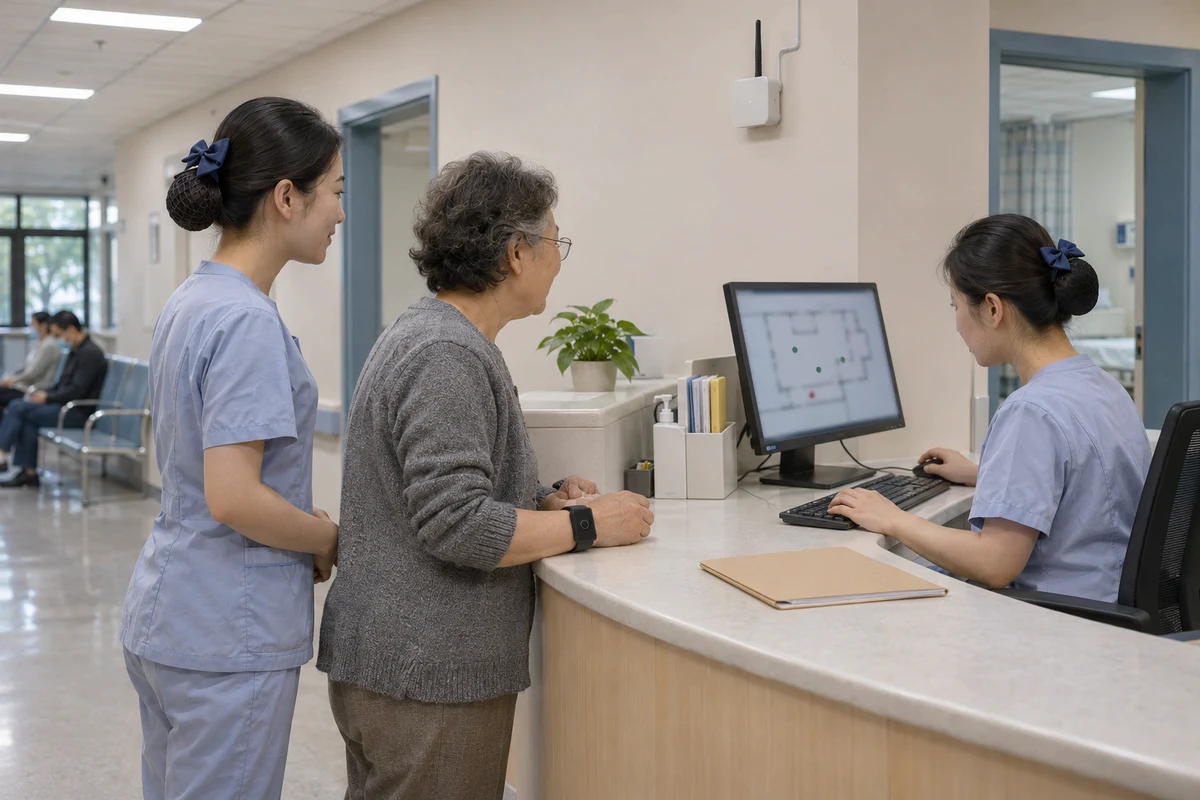
Haoru Technology provides ultra-wideband (UWB) positioning data integration for hospitals where patient locations are dispersed and updates during examinations, preoperative preparation and internal transfers depend on manual checks. By linking patient tags with care tasks, the solution connects arrival, dwell and departure records to hospital applications. Staff can verify patient whereabouts, coordinate transfers and review waiting time across individual stages.
Application Background
An examination or surgical preparation process often takes a patient through waiting, preparation, examination and recovery areas. Nurses, transport staff and receiving teams each handle part of the journey. They need to verify identity, establish whether the previous stage has ended and confirm that the next team is ready to receive the patient.
Existing workflows rely on calling systems, telephone conversations and manual records. If a patient temporarily leaves a waiting area, or a transfer starts before its status is updated, staff must locate the patient and check the situation again. The hospital needs continuous location records while retaining its clinical systems and staff confirmation procedures.
Project Challenges
1. Patient locations and care tasks are separate. A location point does not explain which examination a patient is awaiting, while a task status alone does not establish the patient's physical whereabouts.
2. Boundaries between neighboring rooms and corridors can cause location transitions. Updating a milestone immediately at a boundary would confuse passing through, brief stops and genuine arrivals.
3. Transfers involve several teams. Location records, task states and staff confirmations need a common time reference, with access to patient identity information limited by role.
Haoru Technology Solution
Haoru Technology deploys UWB base stations around selected care units, provides wearable patient tags, and supplies position calculation, trajectory recording and data output. At the start of a visit, a tag is linked to that visit's task identifier. The association is removed afterward so that reuse does not mix records from different patients.
The hospital application manages appointments, departments, transfer tasks and receiving status. Our interface supplies position, tag identification and timing information. Project integration logic combines these inputs with zones, dwell time and task order to generate milestone prompts. Clinical completion and patient acceptance remain confirmed by the relevant application or staff member.
At doorways and neighboring preparation areas, we use site trajectories to refine zone boundaries and dwell rules, reducing events triggered by patients who merely pass through. Each role sees the information it needs: nursing staff see current whereabouts, dispatchers see transfer coordination, and managers see process summaries. Full patient identities are not displayed in public areas.
How It Works
1. Bind identity: associate the tag identifier with the current care task, using a link that can be removed when the visit ends.
2. Collect positions: base stations and tags exchange ultra-wideband, or UWB, ranging signals. The system calculates patient positions from known base station coordinates and attaches timing information.
3. Identify milestones: the hospital application maps positions to waiting, preparation, examination and recovery zones. Dwell time and task order help distinguish arrival and departure events.
4. Coordinate the process: staff use location prompts to verify tasks and complete handovers. The application consolidates milestone records for analysis of waiting time and transfers.
Solution Advantages
1. Staff can view location and task information together, reducing repeated inquiries between departments about a patient's whereabouts.
2. Combining zones with dwell time and task information makes records easier to interpret and allows staff to review why a milestone was generated.
3. Interfaces connect positioning to existing clinical and transfer applications, supporting expansion one care unit at a time.
Final Results
Time spent manually verifying care milestone status decreased by 60%. Staff check the task and current location together, reducing separate telephone inquiries.
The rate of missing information in transfer handovers decreased by 50%. Zone arrival records are cross-checked against transfer tasks, reducing omitted arrival times and receiving status.
Time spent preparing daily process statistics decreased by 70%. Location events are grouped by care task, reducing manual consolidation of registration and transfer records.