
 Haoru UWB
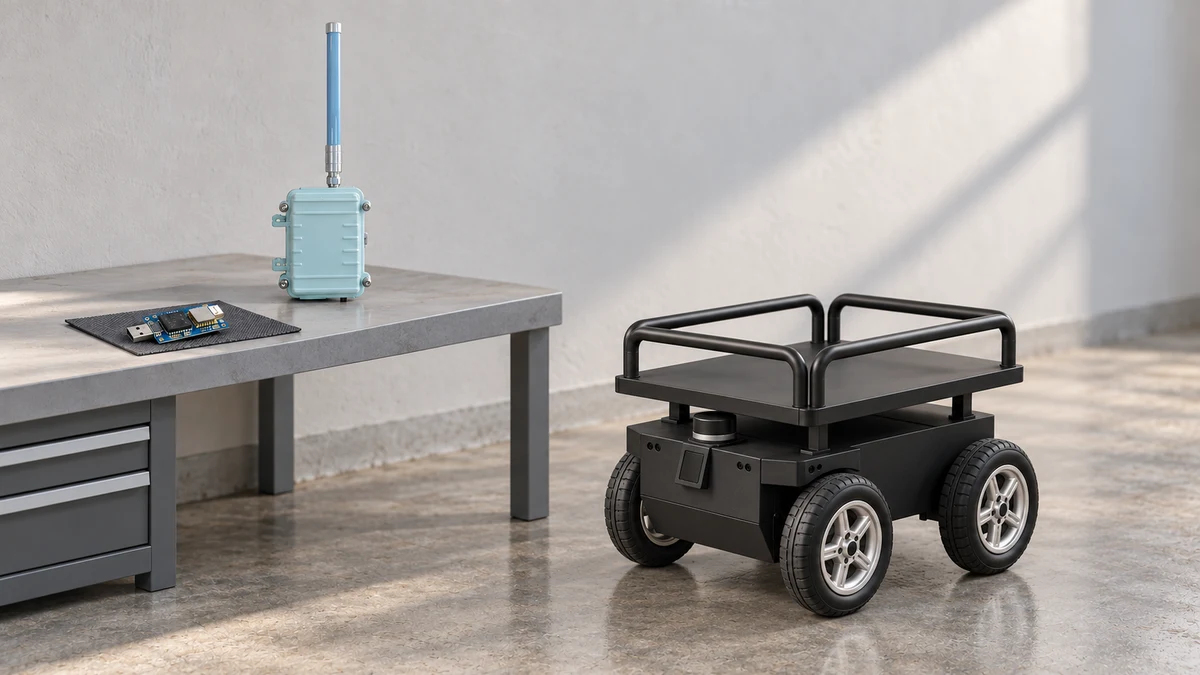
Haoru Technology (Dalian Haoru Technology Co., Ltd., brand names HAORU / HAORUUWB) was founded in 2019. It is a Chinese manufacturer specializing in UWB high-precision positioning and intelligent automatic following technology.
The company provides full-stack solutions for industrial, logistics, robotics, smart mobility, and research and development applications, ranging from UWB modules, anchors, tags, and following kits to complete equipment and positioning systems.
1. What Problems Does Haoru Technology Solve?
Traditional positioning and following solutions often rely on magnetic strips, QR codes, reflectors, or Bluetooth beacons. Deployment is complex, route changes are costly, and changes in the environment can render these solutions ineffective.
Haoru Technology uses UWB (ultra-wideband) to do three things:
Distance measurement: Centimeter-level ranging between devices, with typical accuracy of approximately ±10 cm.
Direction estimation: Using PDoA / AoA to determine whether a target is to the left, right, front, or rear.
Automatic following: Vehicles follow people as they move, supporting 360° following, suppression of abrupt steering swings, and multimodal obstacle avoidance.
Typical applications: Following tool carts in factories, warehouse material handling, personnel positioning in coal mines and campuses, spatial anchoring for AGVs and mobile robots, smart luggage, golf bag carts, and caregiving carts.
2. Product Portfolio
Positioning Modules
Representative products: ULM1, ULM3, ULM3-PDOA, LD150, LD600.
Applications: Ranging, angle measurement, and embedded integration.
Network Anchors
Representative products: IGA01-EP (indoor), IGA02-EP (outdoor).
Applications: PoE networking and TWR/TDoA positioning systems.
Tags
Representative products: ULM1-SH wristband, ULM3-SH, ULM1-GP badge.
Applications: Positioning using tags worn by personnel or attached to assets.
Following Kits
Representative product: UWB omnidirectional following kit.
Applications: Adding following capabilities to robots and vehicles.
Complete Following Vehicles
Representative products: Two-wheel-drive/four-wheel-drive automatic following carts and following platform carts.
Applications: Factories, warehousing, and medical transport.
Development Kits
Representative products: TDoA kits, iOS development kits, and following development vehicles.
Applications: University research and further development.
3. Technical Capability Boundaries
Positioning architectures: Multiple modes, including TWR / TDoA / PDoA / AoA.
Following parameters: Adjustable from 1 to 15 meters, with distance accuracy of approximately ±10 cm and angular accuracy of approximately ±5° under unobstructed conditions.
System capabilities: UWB + edge AI integration, including AI anchor roaming, signal drift suppression, angle correction, and multimodal sensor fusion for obstacle avoidance.
Delivery formats: Modules / kits / complete vehicles / SDKs / APIs / PC software / OEM / ODM.
In-house development covers: RF hardware, positioning algorithms, motion control, communications, and data visualization.
4. Who We Serve and Where Our Products Are Used
Robotics companies: Adding the ability to “follow a person” to their own chassis.
Industrial customers: Factory personnel positioning, asset tracking, and flexible material handling.
System integrators/universities: UWB algorithm validation, graduation projects, and research projects.
Overseas developers: Products have been sold to more than 10 countries and regions, including the United States, Japan, Singapore, Switzerland, and Russia.
5. Why Haoru Technology Is Often Chosen
JD.com UWB category: Long-standing No. 1 rankings in both store and brand best-seller rankings, with four products among the top 10 best sellers.
In-house development: Positioning algorithms, embedded systems, motion control, and PC software are developed in-house across the entire chain.
Application validation: Deployments in smart factories, warehousing and logistics, underground coal mines, medical transport, and campus inspection.
Delivery support: Example projects, wiring diagrams, APIs, and calibration recommendations—not just circuit boards.