
 Haoru UWB
Solution
Abstract
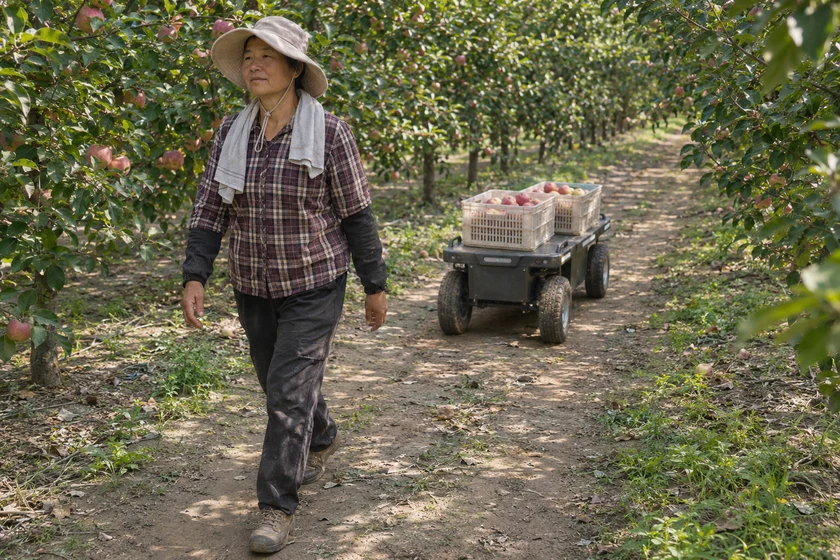
For picking and transport in orchards and greenhouses, Haoru Technology integrates the UWB automatic following kit into customers' own picking transport carts. The carts follow pickers wearing wristband tags automatically, so pickers can place fruit in baskets as they pick without repeatedly carrying baskets, reducing bending and back-and-forth travel and improving picking efficiency.
1. Background
In orchard and greenhouse picking, pickers move between fruit trees or ridges, placing picked fruit into baskets and then carrying them to the transport cart or sorting point at the field edge. When a basket is full, it has to be carried or wheeled away, so pickers make repeated trips between the plants and the field edge, bending and carrying frequently, with a great deal of energy and time spent on handling.
2. Project Challenges
First, frequent handling. Full baskets need to be moved away in time, so pickers make repeated trips between the plants and the field edge, interrupting picking time.
Second, heavy bending load. Picking and basket-filling already require frequent bending, and the added carrying makes the work physically demanding.
Third, scattered work areas. Picking routes in orchards and greenhouses change with ripening progress, and fixed tracks or transport equipment cannot easily adapt to flexible picking routes.
3. Haoru Technology's Solution
Haoru Technology integrates the UWB automatic following kit into customers' own picking transport carts. Pickers wear wristband tags, and the cart recognizes the picker's position through UWB ranging and angle measurement, following automatically with an adjustable following distance of 1 to 15 meters. The cart moves with the picker along the fruit rows and ridges, so pickers place fruit in baskets as they go, and full baskets are carried to the field edge by the cart without manual handling. The cart is equipped with ultrasonic sensors and stops automatically when approaching fruit trees, ridges or people.
4. How It Works
The wristband tag worn by the picker communicates continuously with the UWB base stations installed on the cart. The base stations measure the distance and angle between the picker and the cart, and the following controller drives the motors according to this data to make the cart move forward, turn or stop along the picking route. When the picker stops to pick, the cart stops at a set distance and waits; when the picker moves, the cart resumes following. When the ultrasonic sensors detect an obstacle at close range, the cart stops automatically.
5. Solution Advantages
First, carry as you pick. The cart moves with the picker, so fruit is placed in baskets nearby, reducing trips between the plants and the field edge.
Second, reduced physical strain. Pickers no longer carry baskets, reducing bending and load, and saving energy for picking.
Third, flexible adaptation. The cart moves dynamically along picking routes without fixed tracks, suiting the changing picking rhythm in orchards and greenhouses.
6. Results
Pickers' round trips between plants and the field edge decreased by 50%, with fruit placed in baskets nearby and transported promptly.
Effective daily picking time increased by 30%, with handling time converted into picking time.
Pickers' bending and load-carrying frequency decreased by 45%, reducing physical strain.