
 Haoru UWB
Solution
Summary
Haoru Technology provides ultra-wideband (UWB) assisted position tracking for virtual production involving camera moves, tracking obstruction and spatial data integration. Base stations in the studio track a camera mounted tag. Positions are transformed into the customer's virtual scene coordinates and combined with existing attitude, lens and frame timing information, adding a reference for camera checks, continuity assessment and shot review.
Application Background
Virtual production adjusts the virtual viewpoint as a physical camera moves. Whether the camera travels on a track, mobile platform or handheld path, the production system needs its spatial position together with orientation and lens information to match the image.
The customer already has cameras, tracking equipment and a rendering platform. The team needs an independent position reference to check coordinate consistency when tracking is partially obstructed or cameras are repositioned, and to retain movement records that can be retrieved by shot.
Project Challenges
1. A tag on the camera body or support is offset from the lens reference point. As the camera rotates, attitude information is needed to transform that offset correctly.
2. Position, orientation and lens information are related but come from different sources. A single UWB tag position cannot replace full camera pose tracking or lens calibration.
3. Rendering and external measurements depend on timing. Clock relationships and data age must be established so that older positions are not applied to the current image.
Haoru Technology Solution
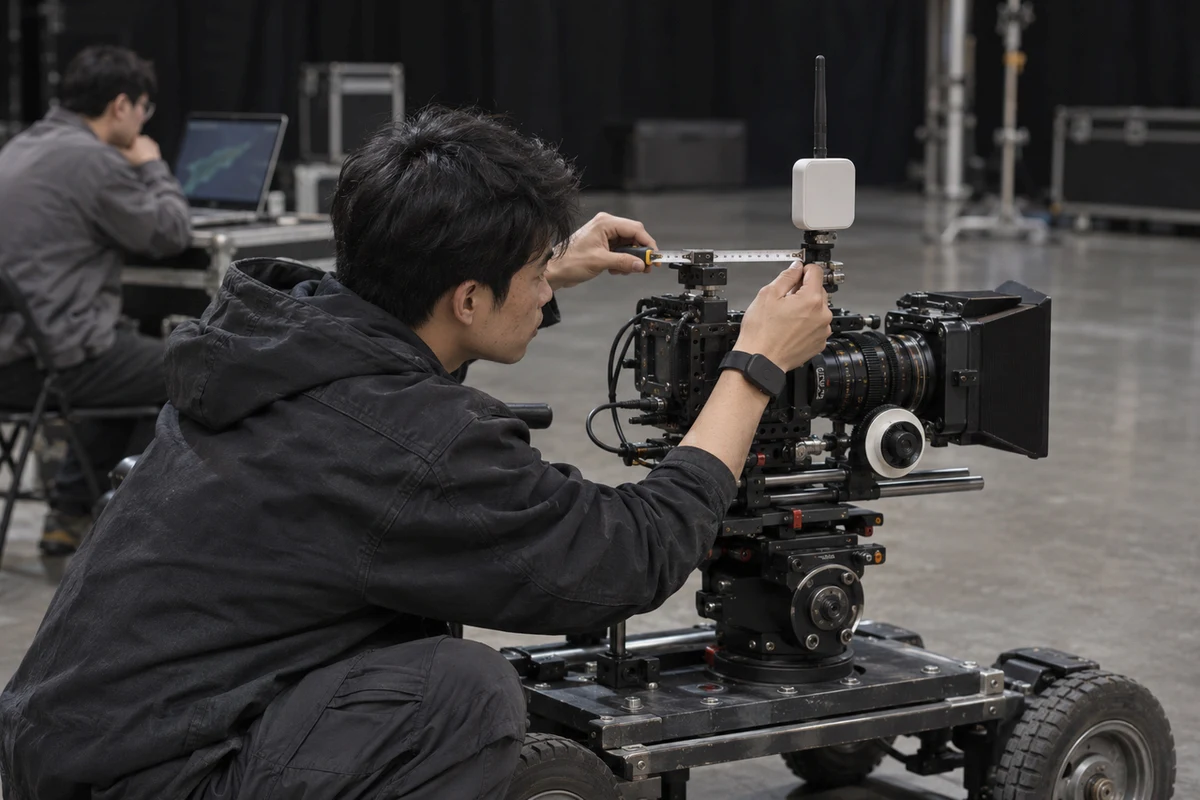
Haoru Technology deploys UWB base stations around a defined shooting area, calibrates studio coordinates and mounts a tag at a suitable point on the camera or support. We provide position calculation, trajectories and data output, checking deployment against obstruction from lighting rigs, display panels and large equipment.
The customer's tracking interface transforms UWB positions into virtual scene coordinates and uses existing attitude data to compensate for the offset to the lens reference point. The original tracking system retains orientation tracking, and the lens system supplies focal length and related parameters. UWB enters as a position observation for fusion and consistency checks.
Project interfaces align timing within the production chain and associate positions, existing tracking data and shot identifiers. When observations are delayed, missing or inconsistent, the fusion program selects or reduces their contribution according to data status. Replay helps the team identify when position jumps occurred and narrow the investigation.
How It Works
1. Calibrate the space: map studio coordinates to the virtual scene and record the mounting relationship between the tag and lens reference.
2. Acquire observations: UWB supplies spatial position and timing while the original systems supply attitude and lens data.
3. Transform and fuse: the customer program handles coordinate mapping, offsets and timing, then uses valid observations for auxiliary tracking and consistency checks.
4. Associate shots: the production platform stores trajectories and data status by shot, supporting checks after camera changes and review of exceptions.
Solution Advantages
1. An additional position source helps identify coordinate inconsistencies and local tracking interruptions within the existing chain.
2. Position, attitude and lens parameters retain clear roles, allowing the customer to use existing equipment without replacing the production system.
3. Shot linked spatial records give on-set engineers and postproduction teams a common time segment for discussing problems.
Final Results
Time spent organizing camera spatial data decreased by 50%. Positions are stored by shot, reducing manual sorting of trajectory files.
Time spent diagnosing position tracking exceptions decreased by 60%. Time aligned sources help the team identify the stage where an exception occurred.
Time spent configuring position mapping after camera changes decreased by 40%. Calibrated site coordinates and mounting relationships reduce repeated setup.