
 Haoru UWB
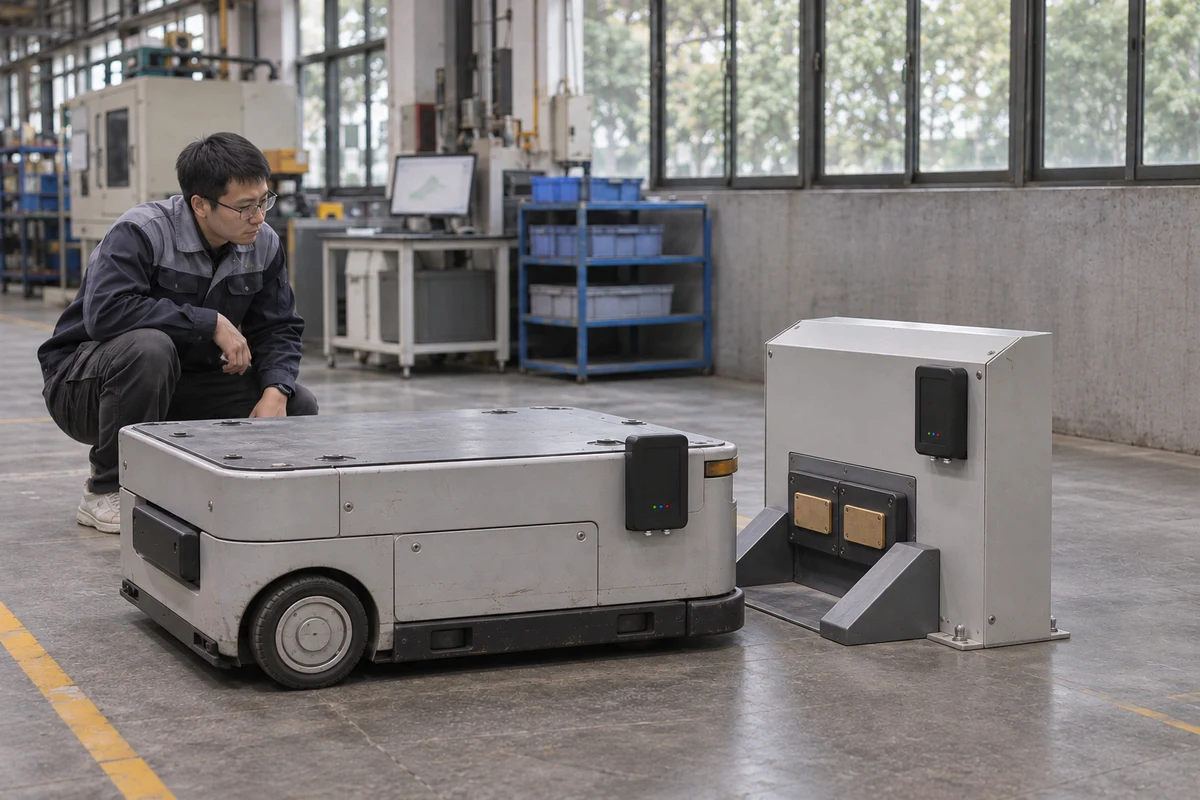
Solution
Summary
Haoru Technology provides ultra-wideband (UWB) assisted docking for mobile robots that repeatedly search for charging or loading stations and require manual alignment. Relative distance and direction measurements give the customer's motion controller a reference during approach. Existing short range sensors, mechanical guides and arrival confirmation complete final docking, linking travel, alignment and station operations.
Application Background
After completing a transport task or reaching a low battery state, a robot must enter a charging station or approach a loading station for material transfer. Navigation brings the vehicle near the station, but the robot still needs to identify the target direction, align its body and confirm that contact or loading conditions are satisfied.
Similar structures, partial target obstruction or an offset starting position can lead to repeated searching and correction. The customer already has a chassis, navigation and station equipment. It needs an independent approach reference to reduce manual vehicle positioning and repeated docking attempts.
Project Challenges
1. A gap exists between arrival in the station area and entry into the docking position. The robot may know its general location without a clear distance and direction relative to the station.
2. A single point distance does not describe full vehicle pose. Approach position, heading and final interface alignment require separate treatment.
3. Charging and loading require independent arrival confirmation. Position data cannot replace contact sensing, mechanical limits or station status feedback.
Haoru Technology Solution
Haoru Technology configures UWB ranging and angle measurement nodes between the robot and station, then calibrates the relationship between measurement reference points and the docking entrance. We output relative distance and direction. The customer controller combines them with robot heading to determine the approach path and reduce unnecessary searching.
Control is divided into stages. UWB observations first help the robot enter an appropriate approach area. The customer's existing vision, short range sensing or mechanical guides then complete precise alignment. Heading comes from the customer's localization and attitude information; a single UWB point observation is not used as a full pose solution.
Charging or loading starts only after the station controller confirms arrival and readiness. Project interfaces record approach, alignment, arrival and departure separately. When a sequence stops, engineers can distinguish position observations, vehicle adjustment and station feedback as possible causes.
How It Works
1. Establish the station relationship: calibrate measurement reference points against the docking entrance and associate the station identifier with the robot task.
2. Assist approach: measure relative distance and direction, which the customer controller combines with heading to adjust the approach path.
3. Complete final alignment: within the designated area, the customer's short range sensors, attitude information and mechanical guides coordinate positioning.
4. Confirm and operate: independent arrival signals and station status authorize charging or loading. The sequence is recorded before task controlled departure.
Solution Advantages
1. Approach guidance, precise alignment and arrival confirmation have distinct responsibilities across sensing and control stages.
2. A relative position reference is added while retaining existing navigation and station equipment, supporting adaptation to different charging and loading stations.
3. Stage records identify where docking stops, reducing repeated testing of the entire sequence.
Final Results
Manual vehicle alignment interventions during docking decreased by 60%. The relative reference helps the robot enter the correct approach area and reduces corrections after missing the entrance.
Time spent searching and adjusting during station approach decreased by 40%. Distance and direction information reduce repeated searches without a clear target reference.
Time spent diagnosing interrupted docking sequences decreased by 50%. Stage records separate position, vehicle alignment and station feedback issues.