
 Haoru UWB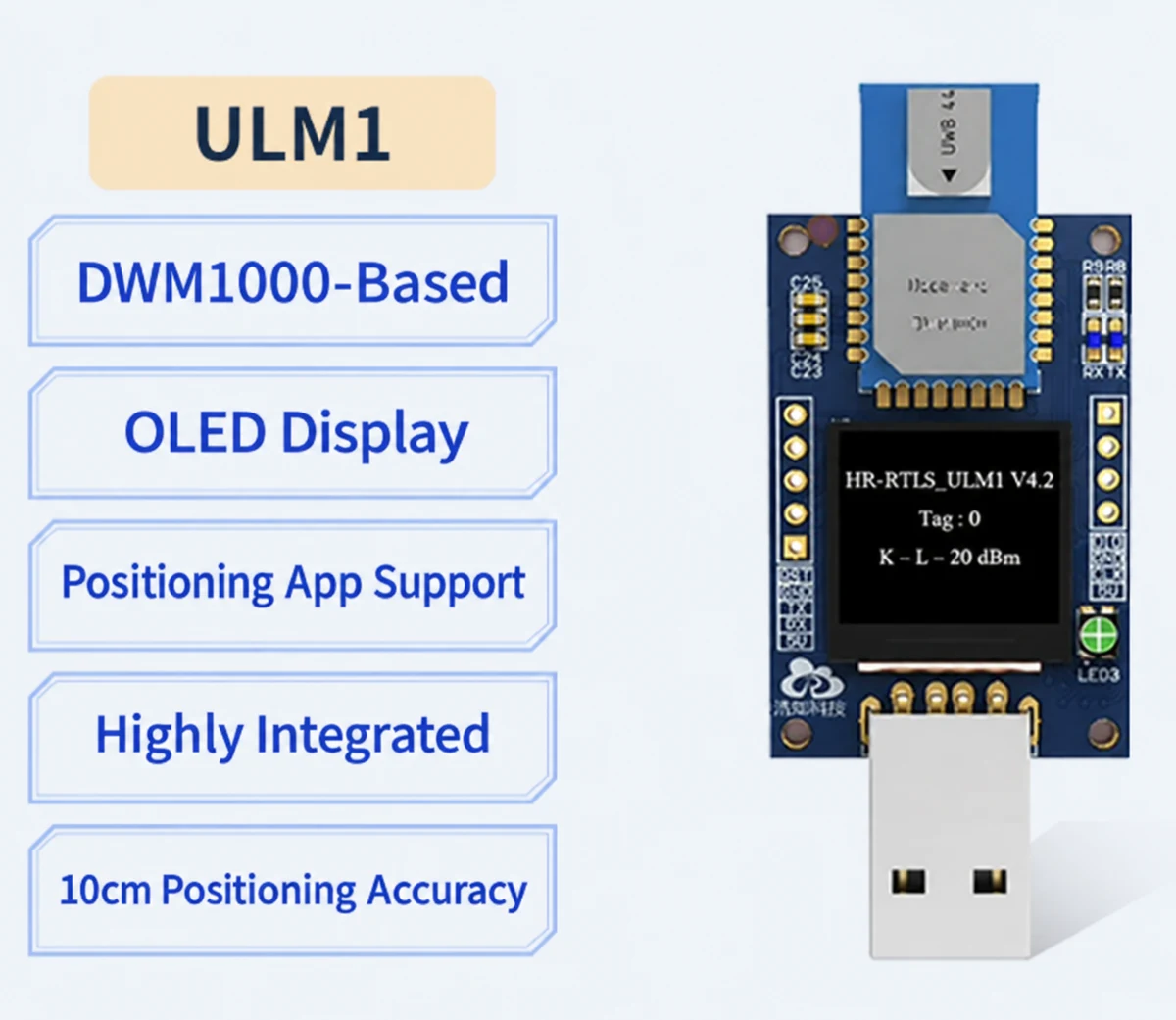
Explore Haoru UWB modules, PoE anchors, RTLS development systems and following kits. Find the hardware, interfaces and documentation for your integration.
Haoru UWB supplies positioning modules, anchors, tags, development systems and following platforms for engineering teams and system integrators. The appropriate starting point depends on whether you need radio measurements, computed positions, a vehicle-following subsystem or a complete evaluation platform.
Modules and tags for embedded integration
ULM1 and ULM3 provide a compact starting point for UWB ranging and multi-anchor positioning development, with USB-to-serial and TTL UART interfaces described in their manuals. ULM1 uses a DWM1000 module; ULM3 uses DWM3000. Select the hardware family and supported firmware together rather than assuming that every UWB device can communicate with every other device.
Other product options address different integration constraints: longer-range modules, an embedded module format, wearable tags and PDoA angle measurement. The ULM3-PDOA module supplies relative range and angle information for supported positioning and following configurations. Compare the required output and mounting arrangement before selecting a part.
Networked anchors and RTLS development systems
IGA01-EP provides Ethernet UDP communication and PoE for an indoor anchor installation. IGA02-EP addresses outdoor mounting with the enclosure and connectors described in its manual. The available firmware formats and network settings must match the receiving application; a network connection alone does not define the positioning architecture.
HR-RTLS1 is the TWR-oriented development path, while HR-RTLS4 documents a TDoA system with a host positioning engine. An RTLS delivery involves more than anchors and tags: coordinate configuration, timing, the network, positioning software and application data handling all affect the result. Start with a representative test area before expanding the deployment.
Following kits and mobile platforms
A robot or cart that follows a person needs target measurements, motion control and a compatible drive system. Haoru offers following modules, kits, development vehicles and vehicle configurations for different integration starting points. The selected obstacle sensors and controller behavior should be evaluated on the intended chassis and in the intended operating modes.
An existing mobile robot may use the UWB measurement interface with its own controller. A cart conversion may require a fuller combination of controller, motor drive, power and sensors. Describe which parts you already have so the proposal can identify what is included, what must be adapted and what remains your application team's responsibility.
Documentation, software and source-code scope
Product pages link available user manuals and relevant development documents. The download centre labels document language: an English title does not mean the entire attached manual is in English. Current English manuals can support an initial evaluation, while some detailed configuration and installation documents remain Chinese.
Development materials differ by model and delivered version. RTLS documentation describes embedded, host-software and algorithm development resources, but this should not be interpreted as an unrestricted licence to every module's internal firmware. Confirm the exact code, schematics, protocols and licence terms in the delivery scope, particularly for PDoA and following configurations. Likewise, availability of a chip feature does not establish finished phone compatibility or an application-ready function.
From evaluation to a project specification
- Define the task: ranging, area positioning, relative direction or vehicle following.
- List the operating environment, coverage, accuracy definition, tag count and update-rate requirement.
- Identify host interfaces, mechanical constraints, power and existing software or controller responsibilities.
- Evaluate a representative configuration using the matching manuals and record the results.
- Agree on hardware, firmware, documentation, support and acceptance conditions before scaling the project.
Start with the UWB module comparison, TWR/TDoA/PDoA guide or following-kit integration guide. Browse products and manuals, or send your project requirements for a configuration discussion.